Company Size: Boutique firm (founded by Angela Sweeney)
Location: Remote / North America
Business Type: Strategic financial advisory for venture-backed startup founders
Project Duration: ~8 weeks
Target Market: Founders and decision-makers at venture-backed startups in SaaS, biotech, fintech, and emerging technologies
This project was developed for Tealeaf Consulting on behalf of EN2H (a software startup), where I worked as a part-time developer. Tealeaf Consulting provides fractional CFO, financial controller, and bookkeeping services to startups looking to scale with intention. The founder brings 20+ years of experience, having helped scale 14+ startups and facilitated 16+ M&A transactions.
2. Business Challenge
Tealeaf Consulting's existing online presence did not reflect the caliber of its strategic advisory services. The challenges were:
Outdated brand perception - The previous website lacked the premium design expected by venture-backed founders evaluating financial partners.
Low engagement - Static content and poor mobile experience led to high bounce rates and minimal discovery call bookings.
Undifferentiated positioning - Competitor financial advisory firms all looked alike; Tealeaf's unique "scale with intention" philosophy was not clearly communicated.
No lead generation mechanism - The site had no clear calls to action or streamlined path for potential clients to book discovery calls.
Poor storytelling - The founder's impressive track record (14+ startups, $100M+ capital raised) was buried rather than featured as a core trust signal.
The firm needed a digital presence that would command the attention of busy founders and convert that attention into qualified leads — all while conveying strategic sophistication and operational competence.
3. Development Process
The project followed an agile methodology tailored for a high-fidelity marketing site:
Phase 1: Discovery & Wireframing - Defining the narrative arc and user journey. Establishing the core "conversion funnel" for discovery calls.
Phase 2: Visual System - Creating a component library focused on high-performance animation constraints, specifically targeting GSAP usage.
Phase 3: Development & Iteration - Integrating GSAP ScrollSmoother and migrating from Vite to Next.js while maintaining strict performance budgets.
Phase 4: QA & Optimization - Cross-device testing for touch/scroll behavior, video loading optimizations, and final SEO/metadata implementation.
4. Challenges Faced
Animation-Heavy Performance - The design called for rich GSAP animations (ScrollSmoother, ScrollTrigger pinning, SVG morphing, parallax) across a single-page layout. Balancing cinematic motion with smooth 60fps performance (especially on the MorphSVG blob background) required aggressive GPU acceleration and careful optimization.
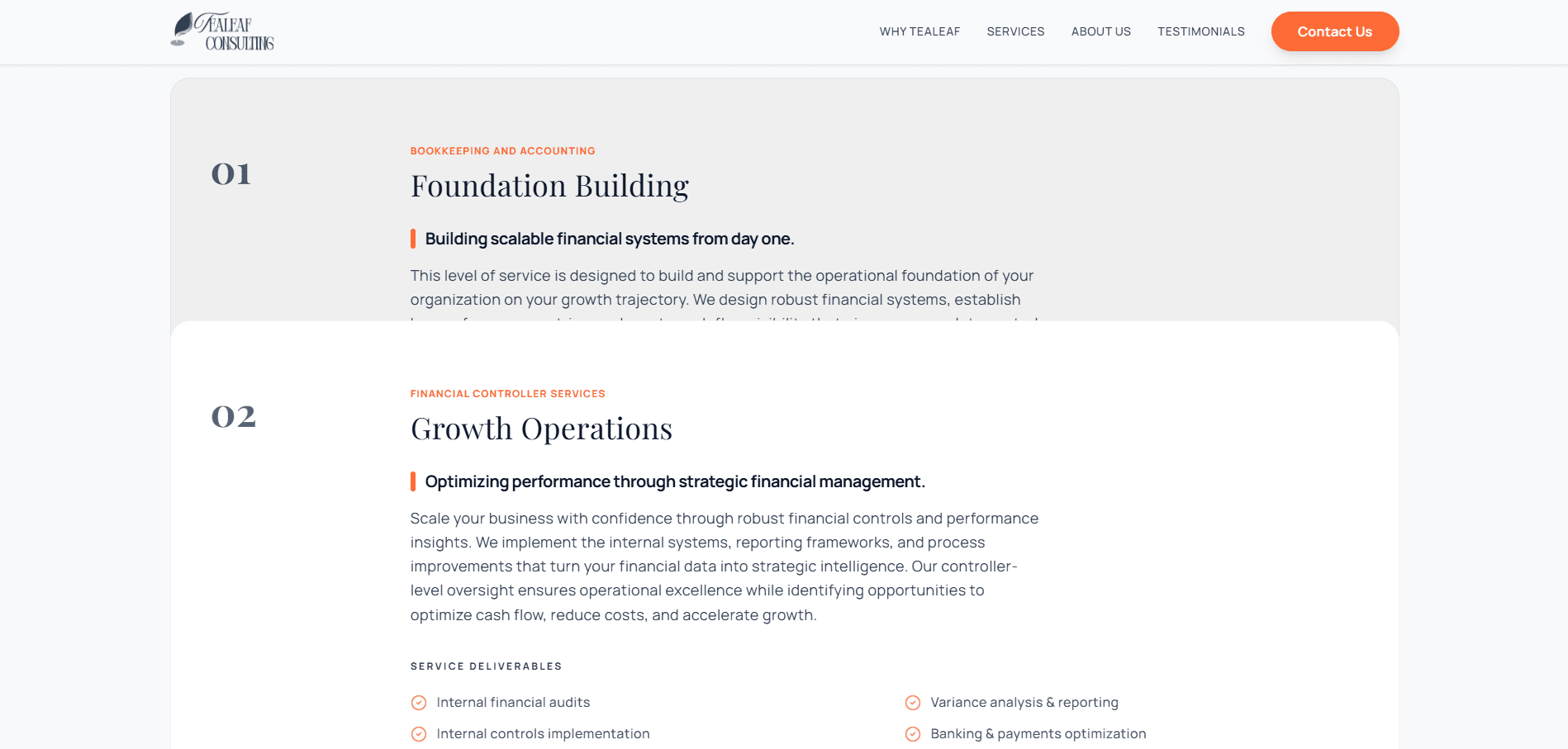
Mobile Responsiveness for Complex Layouts - The service cards section uses a desktop-specific pin-and-stack scroll animation that had to gracefully degrade into a standard card layout on mobile. The accordion-style testimonials also required two entirely different interaction patterns depending on viewport size.
ScrollSmoother Integration - Integrating GSAP ScrollSmoother (which intercepts native scrolling) with Next.js App Router navigation required careful handling to prevent hash-link scrolling from conflicting with the smooth scroll container. Custom scrollTo logic was needed.
Video Hero Performance - The full-screen background video (hero.mp4) had to load instantly on page entry without layout shift or jank, while also respecting user data preferences and device capabilities.
Migration from Vite to Next.js - The project was migrated mid-development from a Vite/React SPA to Next.js 16 App Router. This required reworking routing, navigation, metadata/SEO patterns, and ensuring all GSAP integrations remained stable under React 19's strict mode and server/client component boundaries.
SplitType Text Animation Timing - Character-level text reveals using SplitType had to synchronize perfectly with ScrollTrigger and ScrollSmoother to avoid visual glitches during fast scrolling.
5. Personas
Primary User - Startup Founder (CEO)
Description: Founder or co-founder of a venture-backed startup, typically series Seed to Series B. Time-poor, decision-fatigued, evaluating multiple vendor partners.
Goals: Find a trusted financial advisor who understands startup dynamics. Quickly assess credibility. Book a discovery call with minimal friction.
Pain Points: Frustrated with generic accounting firms that don't understand venture-backed growth. Needs strategic insight, not just bookkeeping.
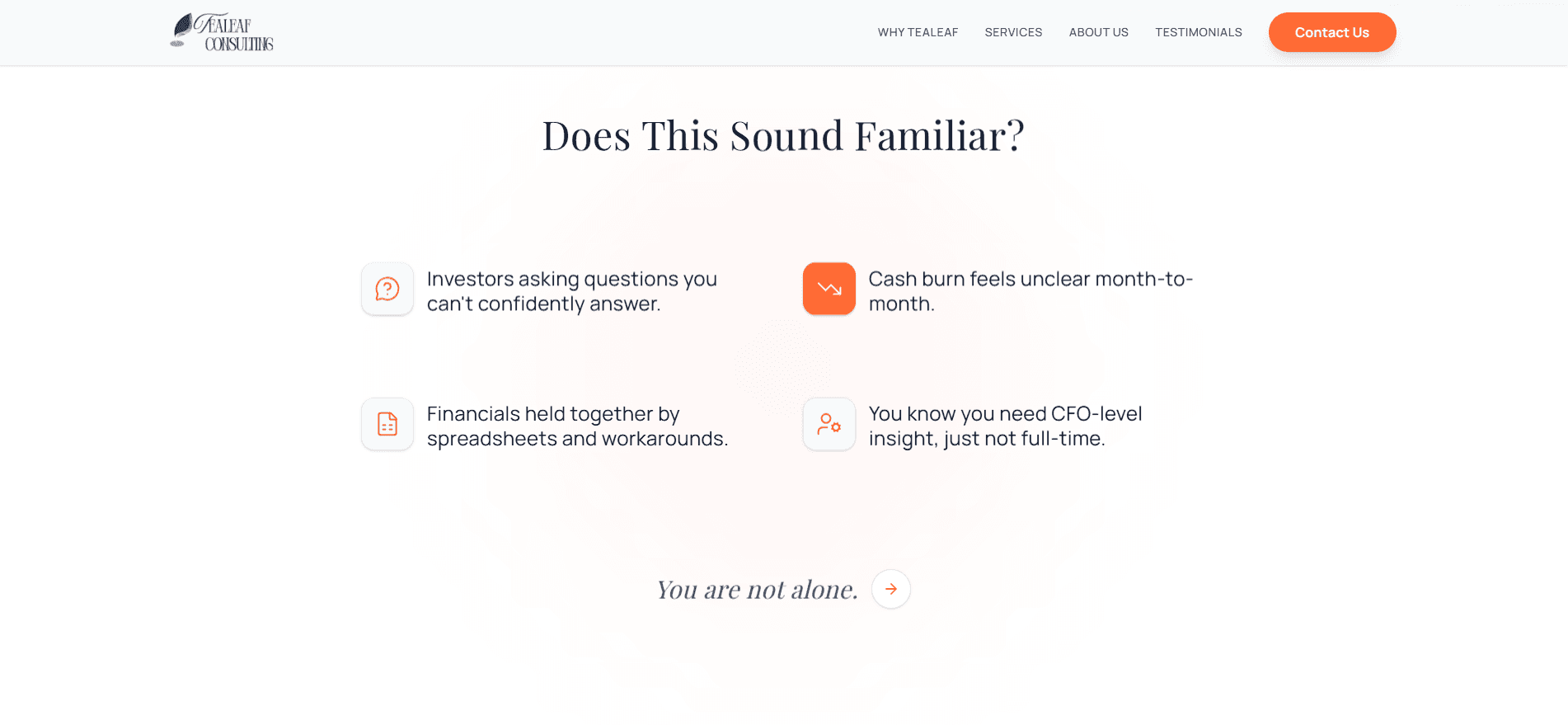
System Usage Behavior: Scans the hero section, scrolls through pain points to validate relevance, reads founder credentials, then books a call. Spends under 90 seconds deciding whether to engage.
Secondary User - Operations/Finance Lead
Description: Head of Finance, COO, or fractional CFO evaluating Tealeaf as a complement to their own team.
Goals: Understand the specific service tiers (Foundation, Growth, Strategic). Evaluate technical competence in financial operations.
System Interactions: Dives deep into the three service pillars, reviews the stats counters, may return multiple times before initiating contact.
Tertiary User - Investor / Board Member
Description: Angel investor or board member who recommends Tealeaf to portfolio companies.
Goals: Quickly validate Tealeaf as a credible recommendation. Access contact information and share the site with founders.
System Interactions: Brief visit — checks credibility signals (stats, testimonials, founder bio), copies email, and forwards.
6. System Overview
6.1 System Diagram
Tealeaf system diagram
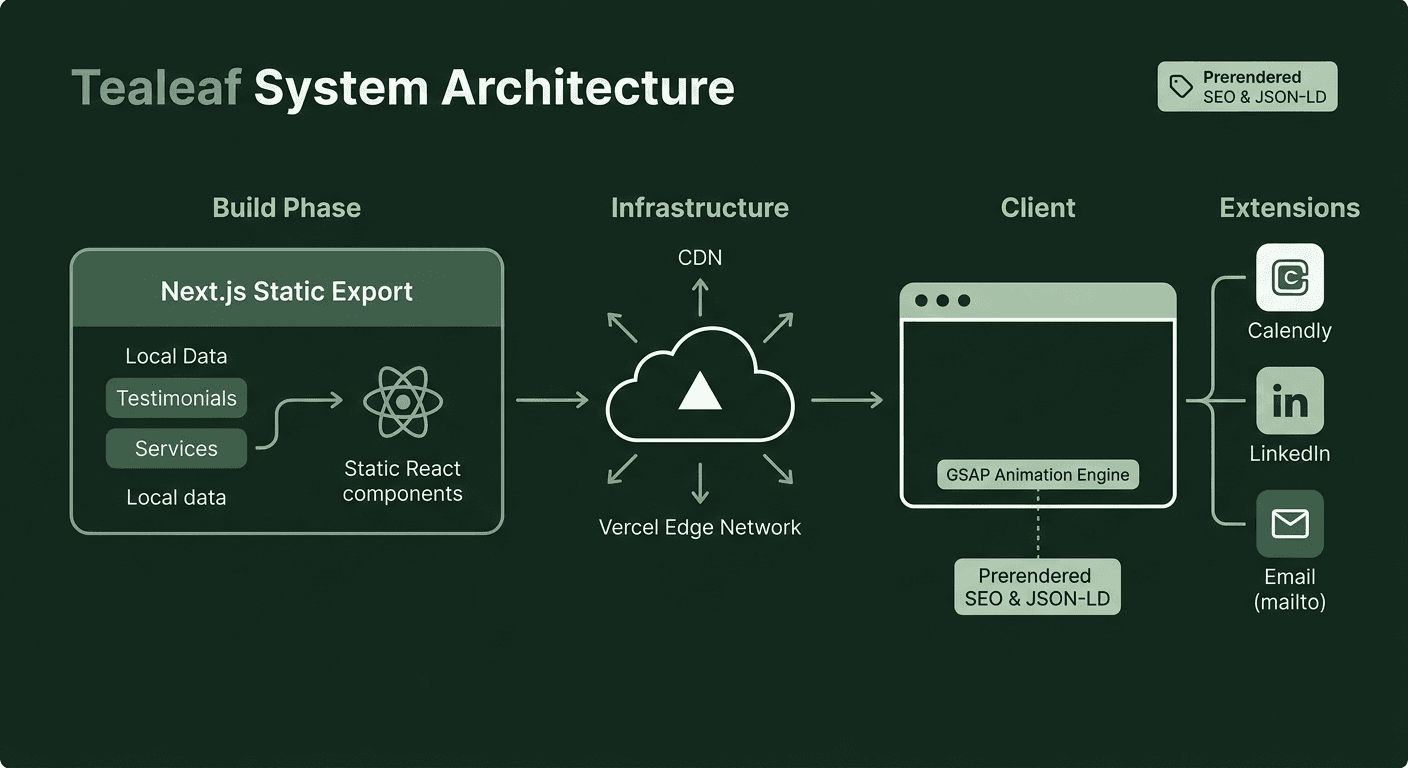
System diagram showing a single-page Next.js application served via Vercel's edge network. The frontend renders static content with client-side GSAP animations. No backend API or database exists. External integrations include Calendly (booking), mailto (email), and LinkedIn. SEO metadata and JSON-LD structured data are prerendered at build time. The architecture is: Browser ← Vercel CDN ← Next.js Static Export ← Build-time compiled React components with embedded data (testimonials, service content).
6.2 Designs
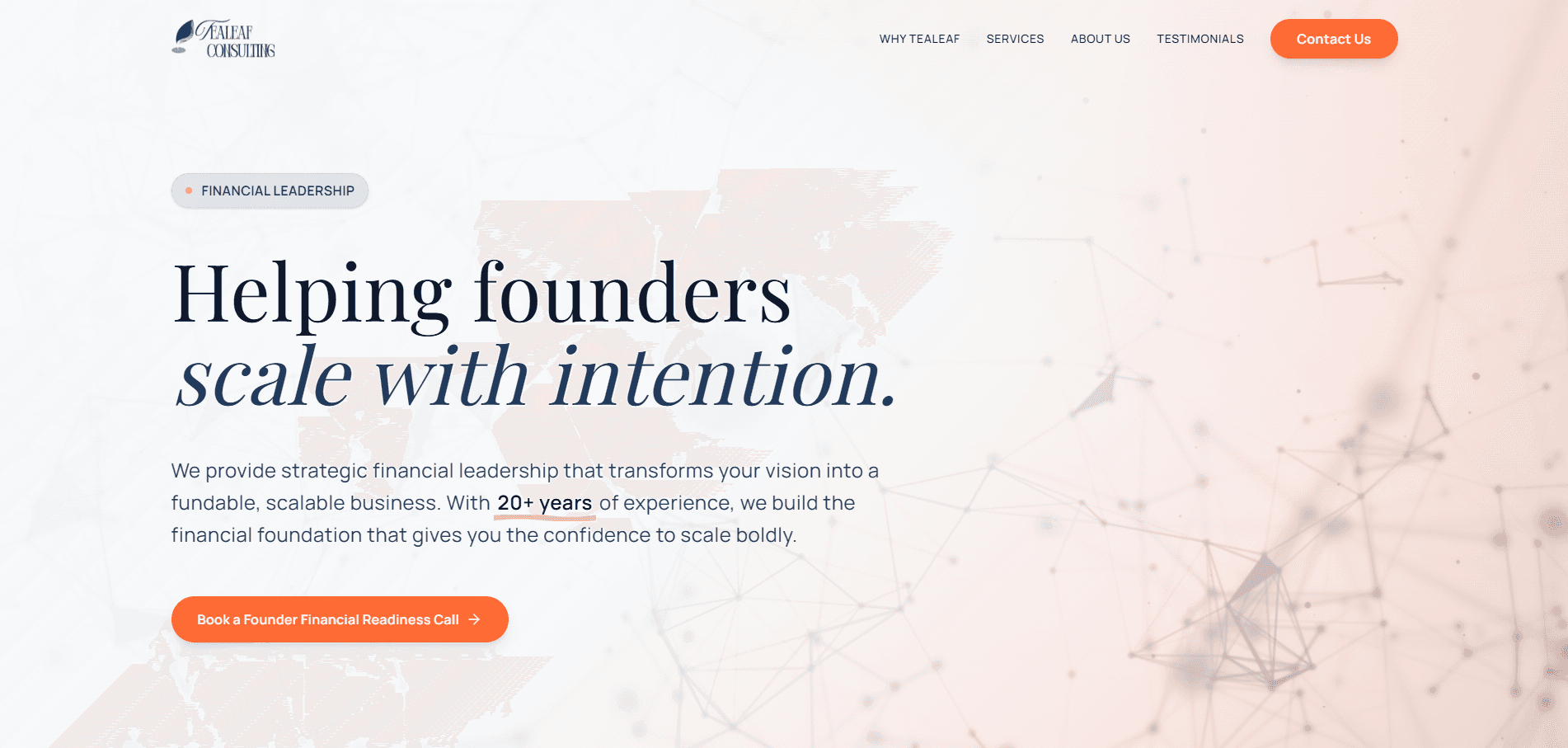
A premium, conversion-focused design was created with a sophisticated navy-and-orange color palette. The visual hierarchy guides visitors from emotional resonance (pain points) through credibility (stats, testimonials) to action (CTA). Key design decisions:
Dark/light contrast rhythm - Alternating between brand-cream and brand-dark sections creates visual pacing and emphasizes key content zones.
Cinematic hero - Fullscreen video background with gradient overlay immediately establishes production quality and brand atmosphere.
Typographic hierarchy - Playfair Display serif for headlines (premium, authoritative) paired with Manrope sans-serif for body text (clean, modern).
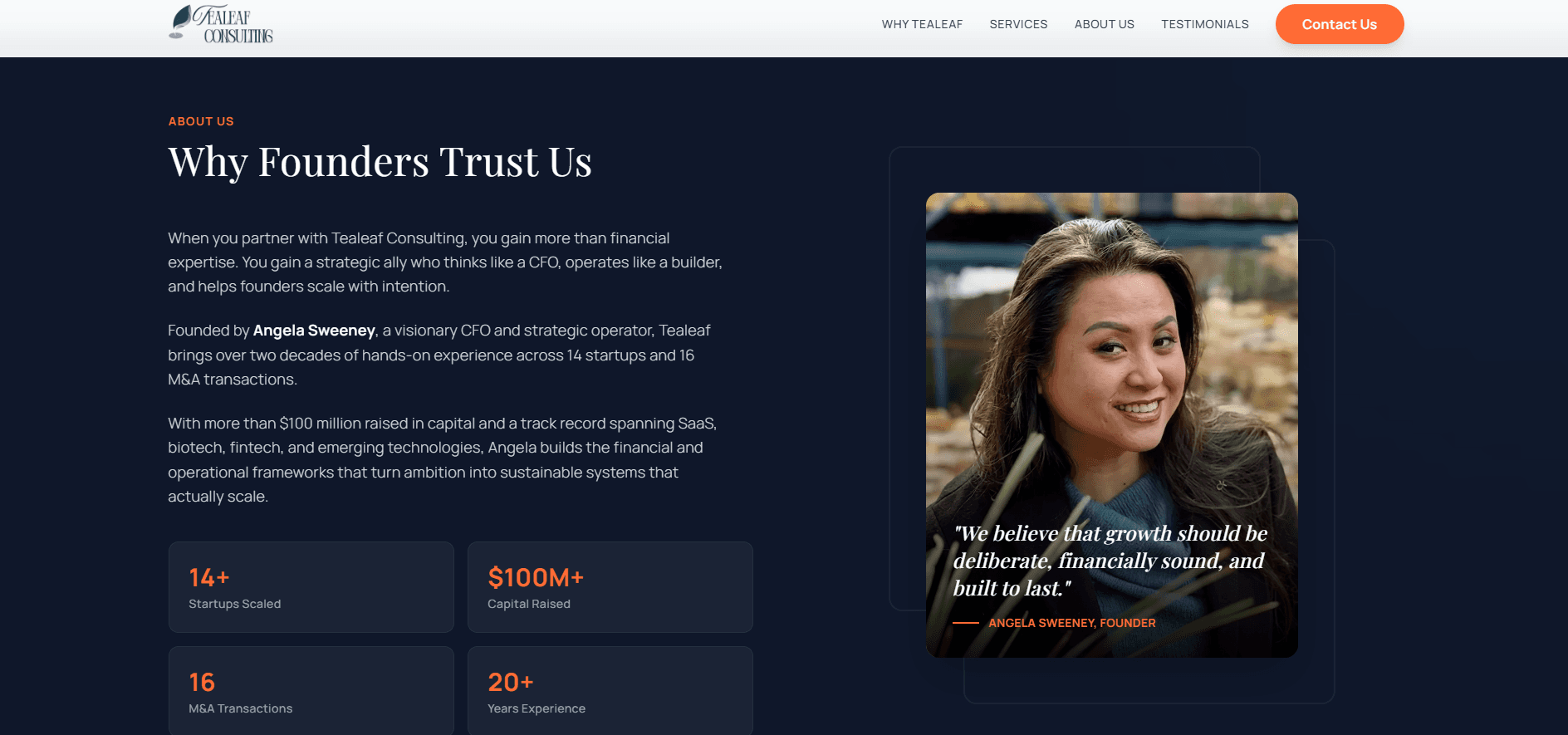
Animated storytelling - Morphing SVG backgrounds, scroll-driven reveals, and a grayscale-to-color founder photo transform passive browsing into an engaging narrative experience.
Conversion-centric CTAs - Strategically placed "Book a discovery call" buttons with the brand-accent orange draw attention at decision moments throughout the scroll journey.
Cinematic Splash Screen - Full-screen logo reveal animation on initial visit sets a premium tone before transitioning into the main page.
Scroll-Driven Narrative - GSAP ScrollSmoother provides buttery smooth scrolling while ScrollTrigger orchestrates section reveals, text animations, and the service card stacking effect based on scroll position.
Three-Tier Service Showcase - Foundation Building, Growth Operations, and Strategic Advisory are presented as "strategic pillars" with a desktop pin-and-stack scroll mechanic that visually reinforces the progression from operational to strategic.
Credibility Dashboard - Animated stats counters (14+ startups, $100M+ raised, 16+ M&A, 20+ years) with a grayscale-to-color founder photo reveal build trust through visual storytelling.
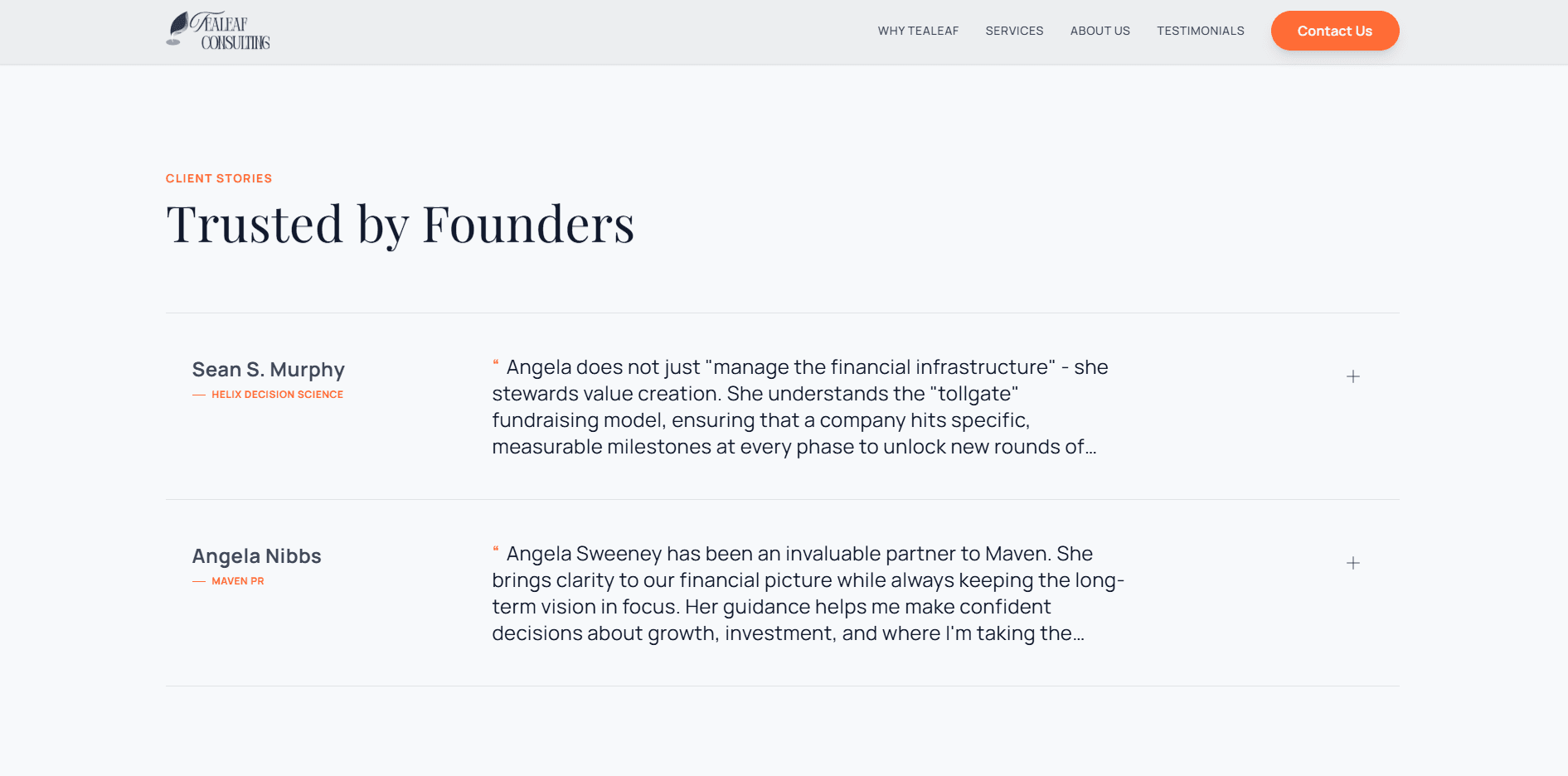
Responsive Testimonials - Accordion-style on desktop (multiple open), expandable cards on mobile — social proof that adapts to the device.
Conversion-Optimized CTAs - Multiple touchpoints throughout the scroll journey funnel visitors toward booking a Calendly discovery call, with a persistent navbar CTA.
SEO & Structured Data - Full Open Graph, Twitter Card, and JSON-LD structured data (Organization, ProfessionalService, WebSite, Reviews) for rich search results.
7. Results and Benefits
Modern Brand Positioning - The site now reflects the premium, strategic nature of Tealeaf's services, differentiating it from generic accounting firms.
Improved Engagement - Smooth scroll animations and narrative pacing keep visitors engaged longer, increasing the likelihood of conversion.
Clear Service Differentiation - The three-tier model (Foundation → Growth → Strategic) is immediately understandable, helping prospects self-qualify.
Streamlined Lead Generation - Strategically placed Calendly CTAs reduce friction between interest and booking a discovery call.
Mobile-Optimized Experience - Responsive design with tailored interaction patterns ensures the site performs across devices without compromising the brand experience.
Future-Proof Architecture - Next.js 16 with strict TypeScript provides a solid foundation for future content additions without technical debt.
8. Lessons Learned
Performance budgeting for animation - GSAP animations must be carefully performance-budgeted. The MorphSVG blob required desktop-only rendering to maintain 60fps on mid-tier devices. Future projects should establish mobile performance budgets earlier.
ScrollSmoother + App Router - Integrating a custom scroll engine with Next.js App Router requires explicit handling for hash navigation and route changes. A ScrollTrigger refresh strategy on route change is essential.
Component-level 'use client' discipline - During the Vite-to-Next.js migration, clearly delineating server and client boundaries early would have saved refactoring time. Every animated component needs 'use client', which limits server-side rendering for those sections.
Video as hero background - Full-screen video creates a powerful first impression but requires careful preloading and fallback strategies. Autoplay policies and data-saver preferences must be accounted for.
Static site simplicity - Choosing a static frontend (no backend/database) kept the project scope manageable and deployment trivial. Not every project needs a CMS — for a marketing site with stable content, static rendering is ideal.
9. Project Goals
Establish premium brand positioning that differentiates Tealeaf from generic financial advisory firms.
Communicate the "scale with intention" philosophy through visual storytelling rather than text-heavy explanations.
Drive discovery call bookings as the primary conversion metric.
Build immediate credibility through prominent display of founder credentials, stats, and testimonials.
Deliver a cinematic browsing experience that reflects the strategic sophistication of the services offered.
10. Performance Optimizations
GPU acceleration - force3D: true, translate3d(0,0,0), will-change: transform applied to all animated elements
Conditional rendering - Heavy background components (MorphSVG blob, parallax shapes) are desktop-only, reducing mobile memory pressure
ScrollTrigger tuning - fastScrollEnd: true, anticipatePin: 1, invalidateOnRefresh for smooth interaction during rapid scrolling
Animation cleanup - useGSAP hooks ensure all timelines and ScrollTrigger instances are properly killed on unmount
Debounced refresh - debouncedScrollTriggerRefresh prevents layout thrashing during resize events
SmoothSmoother touch handling - smoothTouch: 0 disables smooth scrolling on touch devices where it causes friction
11. Future Improvements
Blog/Resources section - Add a content hub for financial strategy articles to improve SEO and nurture leads
Case study page - Detailed client success stories with measurable outcomes (fundraising totals, operational savings)
Service comparison tool - Interactive quiz or matrix helping founders identify which service tier fits their current stage
Newsletter signup - Build an email list for ongoing lead nurturing
Analytics integration - Deeper event tracking (scroll depth, CTA clicks, video engagement) to optimize conversion funnel